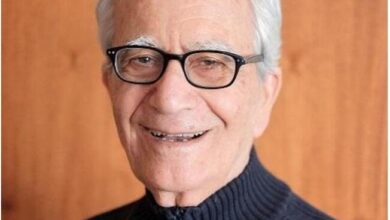
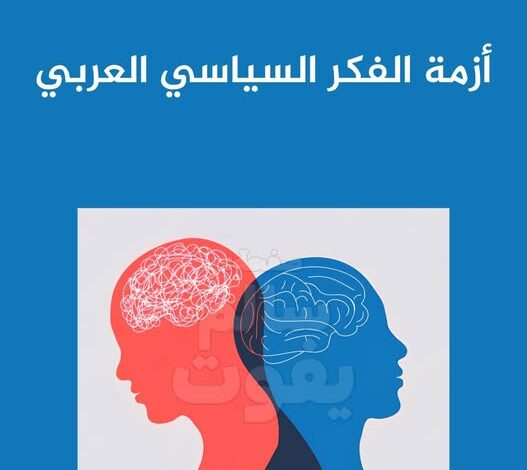
The Crisis of Arab Political Thought – by Radwan El-Sayed and Abdelilah Belkaziz
By Salem Yafoot Translated from Arabic by Ibrahim Ebeid.October 25 ,2025.
”Arab thought has never been able to reconcile originality and modernity without losing one.”
The book starts from a fundamental question:
Why is it that Arab political thought is unable to produce a civilized and political model that expresses itself and keeps pace with the times at the same time?
Through an in-depth intellectual dialogue, the authors attempt to uncover the roots of the Arab political crisis, which goes beyond generalized institutional weaknesses or the absence of democracy, to delve into the intellectual and cultural structures and weaknesses on which Arab political consciousness is based.
The imbalance, as the authors emphasize, is not in practice alone, but in thinking itself: in our conceptions of the state, power, identity, and society.
Main Themes
1. Intellectual Duplication and Cultural Alienation
The authors argue that contemporary Arab thought is torn between belonging to heritage and fascination with the West.
On the one hand, it is tied to the Arab-Islamic past with its values of caliphate and consultation.
On the other hand, it tries to replicate modern Western models (liberalism, socialism, nationalism).
This duality of reference led him to create a special Arab model that combines originality and modernity.
This division resulted in intellectual and cultural alienation that made the Arab elite speak in a language that society does not understand.
It adopts projects that have nothing to do with their reality.
”The expatriate elite took over the leadership of the Arab ship in its attempt to survive the backwardness, proving its inability and failure to reach the shore of safety.”
2. The Intellectual Crisis Before It Was Political
Radwan El-Sayed and Abdelilah Belkaziz assert that the current political crisis is the result of a previous intellectual crisis.
Since the modern renaissance, Arab political thought has been captivated by imported concepts without readapting them to the Arab reality.
Power in our thinking was not understood as a public institution to serve the public interest, but as a property or a booty.
The state was not built on the concept of citizenship, but on fanaticism and personal or sectarian loyalties.
Thus, it is the absence of a mature theoretical conception that has given birth to authoritarian regimes, not the other way around.
”Arab political thought appears to be thinking about the issues of power and the state at its most critical.”
3. The East-West Divide
The authors analyze the impact of the civilizational rupture between East and West on the formation of Arab political thought.
In trying to “reconcile” the two, the Arab thinker fell into the dilemma of contradiction:
Inspired by the West, the concepts of democracy, rationality, and freedom,
But he continued to read it from within a traditional religious or heritage context that does not accept pluralism or individualism.
This paradox has made the Arab discourse hybrid and hesitant: it is neither fully Western nor authentic Arab.
Consequently, it did not produce a coherent civilizational project.
”This may be due to his attempt to reconcile different political models in their experiences and intellectual backgrounds.”
4. The Historical Roots of the Crisis
The authors discuss the possibility that the roots of the crisis could be:
Either in the structure of the old Islamic political thought since the transformation from the Rightly Guided Caliphate to the King,
Or in the colonial domination that disrupted the development of the Arab nation-state,
Or in the post-independence transitions, Ruling During elites failed to build genuine democratic institutions.
Among these possibilities, the authors believe that the crisis is both historical and structural.
Overcoming it requires simultaneously freeing the mind from dependence and imitation, and starting from a realistic reading of the self.
5. Towards a New Arab Political Thought
At the conclusion of the interview, Mr. Belkaziz calls for the renewal of Arab political thought on new foundations:
The centrality of the human being, his rights and freedoms;
Reviving the values of Shura and justice in the light of modern democratic concepts;
Redefining the State as a Social Contract.
Activating a critical culture that transcends blind transmission from the West or the past.
Comprehensive Conclusion
The book The Crisis of Arab Political Thought is one of the most important works that dealt with the essence of the Arab political dilemma from an intellectual and philosophical perspective.
Not only from the perspective of the event or the ruling regime, but also from other viewpoints.
Through an in-depth dialogue between thinkers from the East and the West of the Arab world, the book draws an accurate map of the history of Arab political consciousness.
It reveals that the imbalance in the theoretical perception of the state, power, and identity has led to the current confusion.
Ultimately, the book is an invitation to review the intellectual self and to build an Arab project based on
Freedom, citizenship, justice, and harmony with the cultural identity of the nation