How long will the executioner be rewarded, and will history be let down? By Kamal Abdel Karim, Deputy Secretary-General of the Arab Front for the Liberation of Ahwaz Translated from Arabic by Ibrahim Ebeid – Palestine.
Translated from Arabic by Ibrahim Ebeid - Palestine.
How long will the executioner be rewarded, and will history be let down?
By Kamal Abdel Karim, Deputy Secretary-General of the Arab Front for the Liberation of Ahwaz
Translated from Arabic by Ibrahim Ebeid – Palestine.
As soon as we see this unparalleled rush of some Arabs against an Iranian regime stained with the blood of the Arabs, we realize that the fault is no longer in politics alone, but in memory, in the will, and in the sense of dignity itself. It is not political, wise, or realistic to treat the executioner as an ally, to grant the criminal acquittals, and to present those who have polluted the Arab land by murder and destruction as accomplices, neighbors, or the owners of the case.
When we talk about Iran, we are not talking about a transient disagreement, nor about a limited political rivalry, nor about a natural contrast between neighboring countries, but rather about an integrated hostile project that was founded on the illusion of superiority and fed by a sick expansionist tendency that wore the cloak of religion to hide under it the widest act of sabotage that the Arab Mashreq has known in its modern history.
This project was not born yesterday and was not a reaction to an emergency event. Still, rather an old project in its goals, new in its tools, which Khomeini formulated its foundations, and then Khamenei took over with bloody determination, until the Arab world became an open arena for his influence, militias, arms, and false slogans.
This project entered the Arab countries not as a neighbor but as an invader.
He entered Iraq and transformed it from a centralized state with historical weight into an arena of sectarian chaos, assassination, corruption, dismantling state institutions, and confiscating its national decision-making. He entered Syria not in support of its people or in defense of its land, but as a partner in the killing of Syrians, displacing them and destroying their cities. Then he appointed himself as the guardian of the Syrian decision, as if Damascus were a province of Tehran. He extended to Yemen, turning the suffering of Yemenis into a bargaining chip, igniting a long war, deepening the division, and pushing the country further into collapse, hunger, and devastation.
As for Lebanon, it has been kidnapped from within and established a state above the state, a weapon above the law, and a decision that exceeds the will of the people and state institutions.
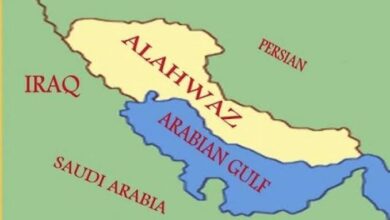
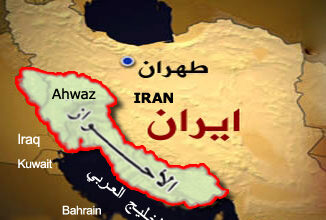
It occupied the Arab Ahwazi for more than a hundred years. It occupied the three Arab islands of the sister countries of the United Arab Emirates, the Greater Tunb, the Lesser Tunb, and Abu Musa.
What kind of policy is this that the Arabs are asked to accept, and what logic does this turn the aggressor into a partner, the saboteur into a friend, and the one involved in Arab blood into a party worthy of respect and courtesy?
What kind of political mind is this that sees the militias funded by Tehran, the corpses left behind, and the cities that have been destroyed, and then asks us to lower our voices in the name of wisdom, balance, and good neighborliness?
No, this is not wisdom, but rather a helplessness disguised as diplomacy and a psychological defeat that is marketed as reason.
Unfortunately, the Iranian regime has succeeded in exploiting Arab weakness, Arab fragmentation, and the Arab vacuum, extending its influence in capitals, buying loyalties, building militias, spreading strife, and then brazenly standing up to speak in the name of Islam, trade in Palestine, and raising the flag of resistance over the piles of Arab ruin.
Nothing is more surprising about this behavior than the suspicious Arab acceptance, the humiliating silence, and the strange willingness to forget bloodshed, transcend the facts, and recycle the crime in the form of a justifiable political position.
The most dangerous thing about the Iranian project is not only its occupation of some Arab countries, but also its success in overturning concepts, as it has made intervention support for support, sectarianism into resistance, militias liberation movements, hegemony a partnership, and the destruction of states to protect sanctities.
This is how language falsifies before it falsifies the facts, and this is how consciousness is deceived before the land is plundered. Unless the Arabs regain their moral and political clarity, they will remain captives of this great deception that adorns them with humiliation, calls brokenness rationality, and presents dependence as a mastery in managing interests.
O Arabs, you are not a marginal nation in history so that you can be allowed so easily, nor a people without roots until your consciousness is reshaped to the scale of the projects of others.
You are a nation whose holy places have been made by God in your land, and from it came the prophets and messengers, and on its soil civilizations were established, and from its language the Qur’an was revealed. In it the seal of the prophets (peace and blessings of Allaah be upon him) was born, you are the owners of this great heritage and this extended geography and this civilizational, spiritual and human depth, so how did you agree that some of you would become false witnesses to the humiliation of their nation, and how did you accept that the Arab capitals should become spheres of influence for a project that sees the Arabs as mere tools, adversaries or fuel for its wars?
It is a shame that the martyrs who were martyred in the face of this expansion should be forgotten and that the sacrifices of Iraqis, Ahwazis, Syrians, Yemenis, Lebanese, and all those who stood up to militias, devastation, and dependence should be erased from Arab memory.
It is also a shame that the Arabs are asked to tolerate those who killed their sons, displaced their people, and destroyed their cities, and then still talk to them about Islamic brotherhood, about Jerusalem, and about the unity of the ranks, as if Arab blood is a small detail that can be exceeded in courtesy statements and pictures of handshakes.
Living nations do not honor those who insult them, nor shake hands with those who plant their daggers in their backs, nor do they grant legitimacy to those who have built their influence on the skulls of their children.
Living nations know their enemy, call things by their names, defend their national security, preserve their memory from absurdity, and respond to aggression with the firmness, clarity, and stance that befits them.
A nation that compromises the definition of its enemy, equates the victim with the executioner, and replaces facts with compliments, is setting itself up for more humiliation, more penetration, and more downfall.
What the Arabs need today is an unflattering awakening, a discourse that is not afraid, and a position that puts Iran in its true position as a hostile expansionist project that has invested in sectarianism, devastation, and bloodshed, and is still seeking to swallow the Arab decision where it can.
What I also need them to do is to regain their self-confidence and to understand that they are no less important than to protect their homelands, no less valuable than to write their destiny with their own hands, and no less dignified than to reject humiliation, even if it is wrapped around the slogans of religion, resistance, and oppression.
It is time for the Arabs to wake up from this heavy illusion.
It is time for them to realize that those who kill their children are not allies, those who destroy their homelands are not partners, those who occupy their decisions are not friends, and those who trade in their causes are not supporters.
It is time for them to regain the meaning of dignity, to rise to the level of their history, and to understand that a nation that does not protect itself is eaten, that a nation that does not preserve its memory is deceived, and that a nation that does not face projects of humiliation is thrown into a state of humiliation.
How long will the Arab continue to applaud those who insult him, and how long will some Arabs remain prisoners of a discourse that justifies the crime, beautifies the ugliness, and gives the aggressor a new opportunity after another, and how long will we continue to see this great legacy when this great nation stands hesitant in front of a project that has never hidden its hostility to it, and has never stopped infiltrating its side, tampering with its security, dismantling its societies and desecrating its sovereignty?
It is not a call for hatred of peoples or hostility to history, but a call for unrelenting clarity, an unrelenting memory, an uncompromising dignity, and an Arab position that knows that those who do not learn from blood will learn from more blood.