Articles
GOLAN HEIGHTS PART -2 BY SALEM SIRRIEH – TRANSLATED TO ENGLISH BY IBRAHIN EBEID
BY SALEM SIRRIEH - TRANSLATED TO ENGLISH BY IBRAHIN EBEID
GOLAN HEIGHTS PART -2
BY SALEM SIRRIEH
TRANSLATED TO ENGLISH BY IBRAHIN EBEID
FOLLOWING PART-1
- 2- Water (9 ) (10)
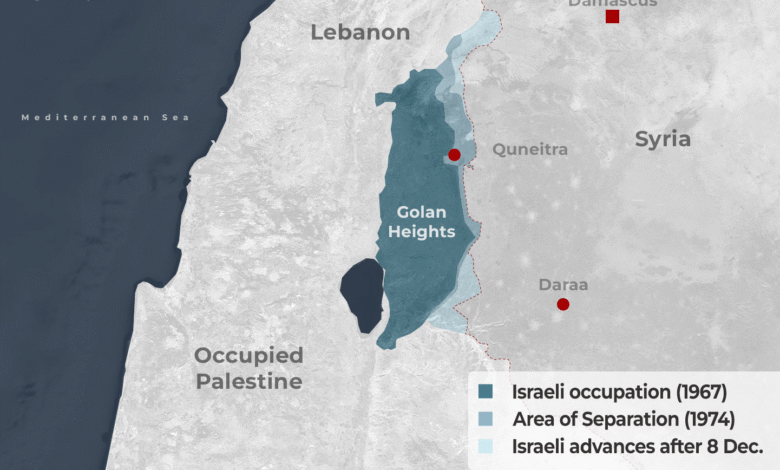
The groundwater reserve in the Golan Heights reaches about 120 million cubic meters, and the basalt rocks spread there to help water seep into the inner layers of the earth due to the many cracks in it. Here, the presence of Mount Hermon is one of Syria’s most essential and wealthiest sources of groundwater. One researcher described it by saying: “Mount Hermon is not just a northern border of the Golan region, but it is the primary geographical factor in the climate of the Golan and the water reservoir in the region. Because of the importance of Mount Hermon, the region has been subjected to several border changes and alterations to control water sources in the Golan .”
87% of the Lake Tiberias Basin’s 900 million cubic meters of water sources are directly linked to the Golan Heights and Mount Hermon, where the Zionist entity supplies about a third of its water needs annually (30%) in various fields. This explains the Golan’s importance in Israel’s “water security” concept because whoever controls it controls the critical water sources in the region.
The Golan is one of the areas of Syria rich in water compared to its small area, as the rate of water resulting from rain and snowmelt is approximately 1.2 billion cubic meters annually, 81% of which is exposed to evaporation, 10% goes underground, and what remains flows on the surface, forming surface water. The Golan, which feeds the border rivers in the region before Israel seized it and robbed it of its waters. - The most important of these rivers are :
1- The Jordan River and its tributaries: the Hasbani, Baniyas, and Al-Dan, all of which originate from the peaks of Mount Hermon and flow into the Jordan River, with a total of up to The Jordan River from all its tributaries is 572 million cubic meters annually.
2—The Yarmouk River originates in southern Syria and forms its southern border with Jordan. It carries approximately 500 million cubic meters annually to the Jordan River.
As for the springs in the Golan, their number reaches 80, and they are weak in abundance. Their water only forms small and short streams on the plateau’s surface, the most important of which is the Baniyas Spring in the north, and the Hamma Springs are famous in the south. It is a hot mineral water with therapeutic and recreational properties. It consists of several springs, some reaching a temperature of 49 degrees Celsius. The discharge rate of the Hamma springs is 63 million cubic meters annually, all of which flow into the waters of the Yarmouk River. The Golan Water Company trades mineral water by selling it. In various containers, its production amounts to 50% of this water’s annual Israeli production rate. Its sales in 1999 amounted to about 320 million shekels.
3- The economic aspect (11)(12): The climate of the Golan played a prominent role in reviving the summer and recreation industry in the region, whether in the hot mineral springs of Al-Hamma or on the top of Mount Hermon and its slopes, which people frequent to practice skiing and tourism. The Golan possesses a natural resource represented by the fish resources found in Lake Tiberias, which the residents used to exploit to secure a source of livelihood for themselves. Still, the Zionists prevented the residents from this profession and extended nets along the shores of the lake to avoid the arrival of fish since 1960. The percentage of workers in the agricultural-animal sector in the Golan Heights reached about 63% of the total workforce in the region. This explains the importance of this sector for the population. The agricultural crops in the Golan are characterized by diversity and quality. Wheat is one of the most important crops grown in the Golan, as it is considered an essential food material. Barley is also extended to feed animals, chickpeas, lentils, and other legumes. Culturing various vegetables is widespread, especially in areas With Palestine with abundant surface water, such as the Butha Plain. The northern regions are famous for growing fruit trees like apples, cherries, vines, and olives.
Table (1): Agricultural production of settlers for the years – 1999-2000
Quantity in tons :
30,000 apples
20,000 corn
10,000 pears
7,500 grapes
7,500 mangoes
1,000 cherries
Al-Ard magazine, no. 1, pp. 69 – 2006.
As for animal production, 113 farms are set up in the Golan settlements. It contains cows that produce 66 million liters of milk annually, or about 7% of Israel’s total milk production, with profits amounting to 110 million shekels. The annual production rate of beef amounts to 40% of the total produced by Israel in its local market, and the revenues from the sale of its meat amounted to about 35 million shekels. The high production rate is due to the abundance of pastures and suitable climatic conditions for this sector.
The Zionist government, in cooperation with China, established a project of fans to generate electricity from wind energy, in addition to oil exploration projects, in addition to a new chocolate fa, story and an institution for making eyeglasses, both of which are located in the industrial zone in Katzrin, and doubled the size of the “Golan Wines factory – due to the abundance of grapes -” with an investment supported by The government amounted to $4 million. Work began on building forty dairy farms, considered one of the largest of its counterparts in Israel, as the government contributes 85% of the construction cost, which amounts to $5 million, in addition to making improvements worth millions of dollars to the ski and tourism facilities, at the top of Mount Hermon.
4- Antiquities – Theft and falsification of Golan antiquities ( 13)
Immediately after occupying the Golan, the Israeli occupation authorities, in cooperation with the Israeli Antiquities Department, began a research and excavation operation “to find tangible evidence that establishes evidence that the Golan is the country of Bashan, Macca, and Geshur mentioned in the Old Testament books.” To consolidate its occupation of the region and justify its annexation. Based on racial and religious foundations and to serve expansionist political goals, the occupying authority, represented by the Department of Antiquities, transferred the found antiquities to Israeli museums, claiming that they were antiquities of hidden Jewish sites after moving these antiquities to artistic laboratories. Hebrew words are engraved on it to convince foreign tourists of the Jews’ right to the region.
It also converted several ancient Christian churches into Jewish synagogues, organized tourist trips to these sites, and published many advertisements on websites, and is still publishing.
It is worth mentioning that since the beginning of its occupation of the Golan, the occupation authorities have demolished most of the Syrian Arab villages, including their antiquities, and razed their buildings to the ground. The city of Quneitra, with its ruined buildings, remains a witness to the barbarism and brutality of the Zionist occupier.