OGADEN-SOMALIA BY SALEM SIRRIEH – TRANSLATED TO ENGLISH BY IBRAHIM EBEID
BY SALEM SIRRIEH - TRANSLATED TO ENGLISH BY IBRAHIM EBEID
OGADEN-SOMALIA
BY SALEM SIRRIEH
TRANSLATED TO ENGLISH BY IBRAHIM EBEID
The Arabism of Somalia: Hussein Abdullahi Belhan believes Somali identity has Arab roots shaped by the tribe’s culture, heritage, and traditions, while acknowledging minorities with other identities. (1)
Fawzi Makkawi says that many manifestations, landmarks, and conclusions, as seen by paleontologists and archaeologists, show that they are Arabs who migrated to the Horn of Africa after drought emerged in the Arabian Peninsula. (2)
Somalis are proud to be members of Arab tribes descended from the Arabian Peninsula, especially from the Quraysh. They are pleased to form a unified community with religion, language, and traditions. However, several local dialects exist, and the stimulating and unifying impact of Arab-Islamic influence was more significant on Somalis than on any other people in North Africa; Islam became a unifying factor in Somali civilization. When the Islamic State weakened, its authority over the regions was weakened, so several local emirates were established and ruled by tribal sheiks. Somalia joined the Arab League on 14 February 1973. (3)
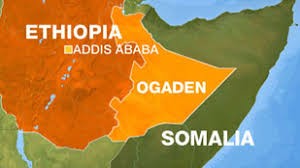
Ogaden Region: Ethiopia assisted Britain during its military campaign to eliminate the Mahdist revolt in Sudan. Britain then ceded the West Somaliland region (Ogaden) to Ethiopia under the Treaty (1897). In September 1948, Britain ceded administrative supervision of Ogaden to Ethiopia.
The western Somali region (Ogaden) consists of many provinces, the most important of which are Harar, Sidamo, and Balih), all located in western Somalia. Most inhabitants are Somali, and many are nomads. It is a semi-desert region with an area of 327,000 km2 and a population of five million people (according to the 2012 census), and what distinguishes the region is the diversity of agricultural crops and livestock, as it is rich in oil and many minerals, such as gold, silver, copper, mica, and tin. (4)
With the end of 1969 occurred new factors led to a change in the balance of power and to the escalation of the conflict between Ethiopia and Somalia, in Somalia occurred a military coup on the third of November 1969 led by General Mohamed Siad Barre where the army leaders controlled the government was announced Marxist-Leninist approach policy for Somalia and hastened the new government led by Siad Barre to go towards the Soviet Union asking for support and aid in the face of European and American support for Ethiopia, and the Soviets considered that the new system represents A valuable opportunity for them to penetrate into this strategically important country Since then, the Soviets focused their relations with the Horn of Africa region and Somalia in particular, and this was represented by a military agreement with it in the early 1970s to train and equip its forces and another agreement in September 1974 and under these agreements the Somali forces became one of the strongest and best military forces in Africa, equipped with modern aircraft squadrons, and in return the Soviets obtained military facilities in the Somali port of Berbera near the southern entrance to the sea. Red. (5)
At the same time, Ethiopia witnessed transformations no less important than what happened in Somalia; in February 1974, the Ethiopian Empire witnessed a military rebellion that eventually led to the removal of Emperor Haile Selassie and the establishment of Marxist-Leninist rule on September 12, 1974 led by Mengistu Haile Mariam, during which period fighting escalated in the occupied region of Eritrea against the Ethiopian presence, which was draining the enormous military and economic capabilities of the Ethiopian government.
The Somali government was optimistic about Mengistu Haile Mariam’s rise to power in Ethiopia, and it also raised the banner of the Marxist-Leninist approach, in addition to the support both sides enjoyed from the Soviet Union. All these factors led the Somali government to believe the new situation could radically solve the Ogaden problem. However, Somali optimism was quickly dashed as the Ethiopian government raised the banner of absolute militancy towards separatist movements in Eritrea and the Ogaden, announcing that it would crush them by force of arms. (6)
At the beginning of 1975, the Soviet strategy was severely tested in the Horn of Africa, especially after Mengistu Haile Mariam came to power in Ethiopia. Still, the border problems between Ethiopia and Somalia, especially the Ogaden, were a stumbling block to developing relations between the two countries and the Soviet Union. He tried to mediate a solution to the border dispute. He offered Somalia to freeze his demands in the Ogaden and to establish a federal union between Somalia, Ethiopia, and South Yemen because these countries overlook from the west and east the southern entrance to the Red Sea and border the Bab al-Mandab Strait from both sides, a solution put forward by Cuban President Fidel Castro when he visited the region in March 1977 during a meeting with South Yemeni President Salem Al-Rabie, Somali President Mohamed Siad Barre, and Mengistu Haile Mariam. However, the Somali government rejected these mediations and demanded that the Soviet Union provide political support for Somalia’s border demands. Still, the Soviet Union began to provide military aid to Ethiopia through Libya. Cuba and South Yemen offered military assistance to Ethiopia. Hence, on November 13, 1977, Somalia decided to expel the Soviet experts and cancel the Soviet-Somali friendship treaties of 1970 and 1974. Thus, the Somalis lost Soviet support, which turned with all its weight to Ethiopia, and the Soviet and Cuban experts began to work with the Ethiopian forces, especially after Ethiopia severed its relations with the United States in April 1977; this was an opportunity for the Soviets and Cubans to present themselves as an alternative by providing military and economic assistance to the new regime in Ethiopia. The Ethiopian army (17,000 Cuban officers and soldiers and 300 Soviet military experts) was enlisted, and this assistance had a significant impact on the military situation in the Ogaden region. Thanks to all this, the Ethiopian forces launched a military offensive in early 1978, in which they were able to regain control of the Ogaden region after the Western Somali Liberation Front (FLF) was able 1977 to achieve significant victories over the Ethiopian regime, announced by the leader of the Western Somali Liberation Front Abdullahi Hassan Mohamud, where 100 cities were liberated, and 90% of them were captured. But it returned to Ethiopia thanks to Castro’s soldiers, the deputy commander of the Soviet ground forces, who oversaw the battles in the Ogaden, and the support of Marxist South Yemen. (7)
Having seized the territory of the Ogaden, Ethiopia has been persecuting innocent people for more than a century: murder and torture, displacement and starvation, ignorance and genocide, racial liquidation, and ethnic cleansing. All these brutal methods continue today.
References:
1. Balhan, Omar Ainu and Hussein, University of London website: A debate on Somali identity and the situation of minorities, see link (accessed: 17 December 2015).
https://www.youtube.com/watch?v=kRfIUpJGUn8. 
2- Fawzi Makkawi, Somalia in Antiquity – Comprehensive Survey of the Somali Democratic Republic, Baghdad – Institute of Arab Research and Studies 1982, pp. 93-94
3-https://www.cia.gov/library/abbottabad compound/1A/1AFE74FD4C0281E64E254599C51222D6_2007-2.pps.pdf
4-
https://ar.wikipedia.org/wiki/%D8%A3%D9%88%D8%BA%D8%A7 %D8%AF%D9%8A%D9%86
5- Said Shakhir Sawadi – Western Somali Region (Ogaden) and the facades of the Somali-Ethiopian conflict. Wasit University – College of Education – Department of History.
6 – Samira Abdul Razzaq Abdullah – the Somal-Ethiopian dispute over the Ogaden 1960-1978 – University of Baghdad – Journal of the College of Education for Girls – Volume 26 (1) 2015
7- Ammar Fadel Hamza – Dhi Qar Arts Magazine No. 2 Volume 1 December 2010
The role of the Soviet Union in the Somali-Ethiopian conflict over the Ogaden 1977-1978
More details in:
8-https://www.youtube.com/watch?v=vAr-Bl9Cu1I
9-https://www.youtube.com/watch?v=q2_1zh15njI